
TL;DR:
-
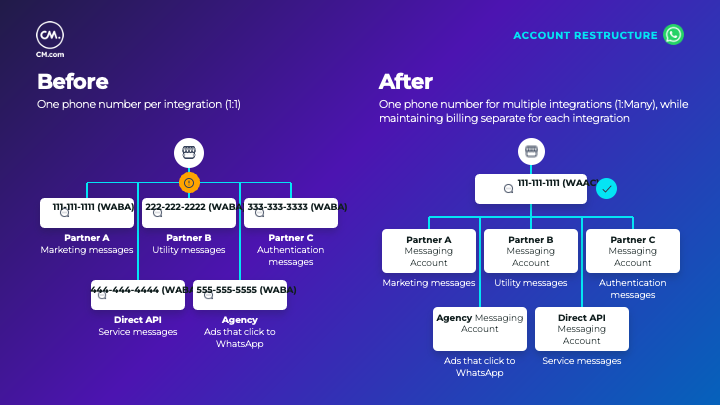
Before October 2026: one number (WABA) owned by one BSP
-
Per October 2026: one number (WAAC) supports multiple BSPs with separate Messaging Accounts
Changelog
|
Aspect |
Before October 2026 (WABA) |
Per October 2026 (WAAC + Messaging Accounts) |
|---|---|---|
|
Phone Numbers |
1 phone = 1 use case (marketing, orders, support = 3 numbers) |
1 phone = unlimited use cases (1 number for all) |
|
Customer View |
See fragmented phone numbers from same business |
See consistent phone number and business identity |
|
Ownership |
One account owned by single BSP |
One phone (WAAC) supports multiple BSPs |
|
Billing & Templates |
Bundled in one account |
Separate per partner (Messaging Account) |
|
API Breaking Changes |
N/A |
None until 2028 H1 |
Account Assets Overview
|
Asset |
What It Is |
|---|---|
|
Phone Number |
The WhatsApp number customers contact (e.g., +1-555-0001). One number now supports multiple integrations. |
|
Business Profile |
Customer-visible info: name, category, hours, address, website, email, profile image. Shared across all Messaging Accounts using the same phone number. |
|
WhatsApp Account (WAAC) |
Container holding your phone number(s) and business profile. Represents your business identity. Can be shared with multiple partners. Owned by: business or CM.com as a BSP. |
|
Messaging Account |
Operational layer for one use case or partner. Holds templates, billing, webhooks. Each partner gets their own isolated account. Owned by: business or CM.com as a BSP, accessed by partner. |
A Shared WAAC
The WhatsApp Account (WAAC) is the business identity layer. It's the phone number and business profile your customers see.
What it contains: Phone number(s), business profile (name, hours, address, etc.), business information.
Key capability: A WAAC can now be shared with multiple partners simultaneously. Before, each partner needed their own phone number. Now, one phone number (WAAC) supports multiple integrations.
Who owns it: Business
Messaging Account
The Messaging Account is the operational layer. It's where partners manage their specific use case: templates, billing, webhooks, integrations.
What it contains: Message templates, billing configuration, payment method, webhooks, API settings.
Key capability: Each partner (or internal team) gets their own Messaging Account. Completely isolated from other accounts using the same phone number.
Who owns it: Business or CM.com as a BSP, but accessed by the partner for their specific work.
Examples (all using same phone +1-555-0001):
Retail Business with Internal Teams
-
Marketing Messaging Account: Campaigns, templates, billing code: MARKETING-001
-
Orders Messaging Account: Confirmations, templates, billing code: ORDERS-001
-
Support Messaging Account: Customer service, templates, billing code: SUPPORT-001
Agency Serving Clients
-
Client A WAAC: Phone +1-555-1000, profile "Client A Business"
-
Agency Marketing Messaging Account: Manages campaigns for Client A
-
Agency Support Messaging Account: Manages support for Client A
Developer Using Direct API + Platform Partner
-
Developer WAAC: Phone +1-555-2000, their business profile
-
Direct API Messaging Account: Developer's own integration
-
Platform Partner Messaging Account: Partner's integration (separate billing, templates)
Roadmap
End of September 2026: Automatic migration on all Meta surfaces (Meta Business Suite, WhatsApp Manager, Embedded Signup). All existing integrations remain fully compatible through 2028 H1.
What you'll see:
-
WhatsApp accounts tab: Phone numbers, sharing settings, partner permissions
-
Messaging accounts tab (new): Billing, templates, payment methods per partner
-
WhatsApp Manager Insights: Now shows by messaging account (not WABA)
For developers: No breaking changes until 2028 H1. All API endpoints, phone IDs, tokens, templates, billing remain backward compatible. Optional new messaging_account_id parameter available for billing separation.