
Overview
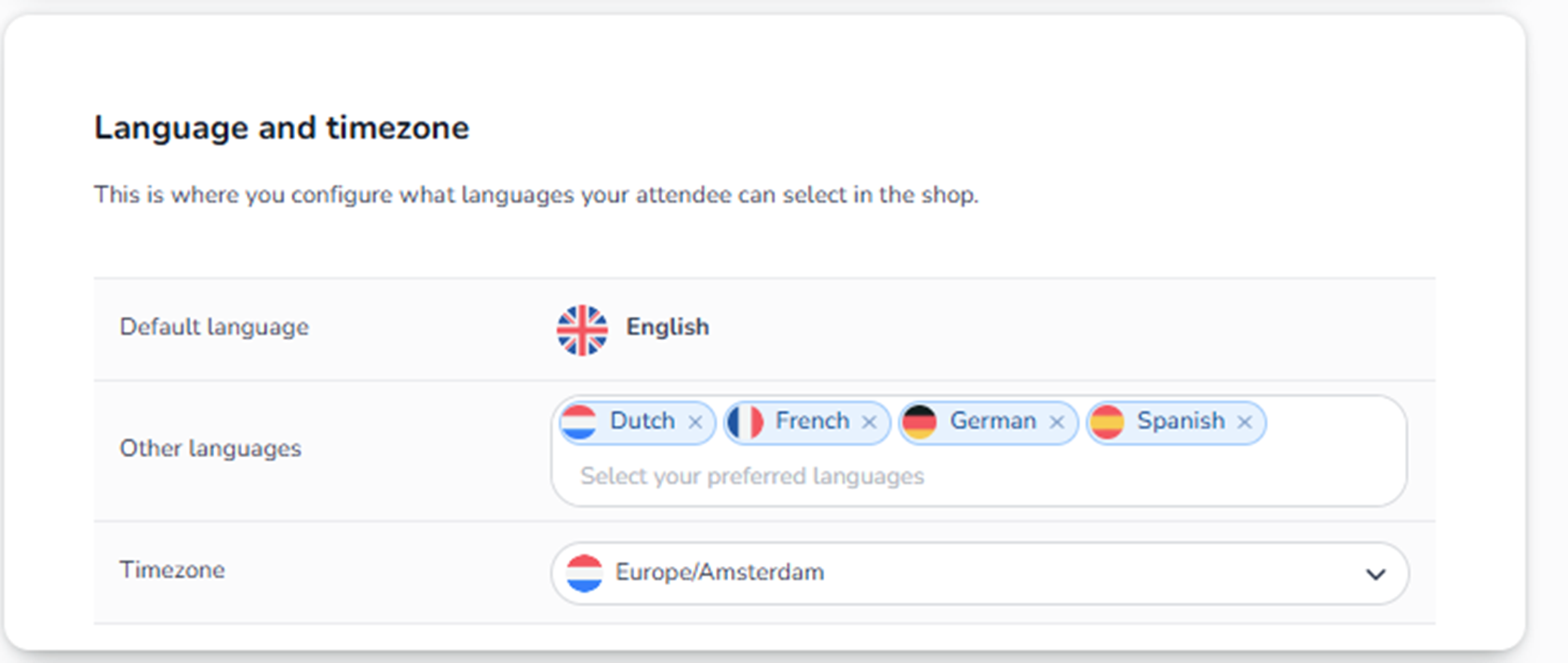
The Language and timezone section controls:
-
Which languages are available in the shop
-
What the default language is
-
Which timezone the event operates in
This directly affects how buyers see the shop and how time-based logic functions.
Default Language
Field: Default language
The default language setting in Event Settings is always set to 'English' and cannot be changed in the interface.
What it controls:
-
Shop interface language
-
Checkout labels
-
System messages
-
Possibly email templates (if multilingual configured)
The default language is used when:
-
A visitor's browser language does not match available options
-
No manual language selection is made
-
No language is specified in the URL
Force a Different Default Language via URL
While the Event Settings default is always English, you can force a different language to load by default by adding a language code to the shop URL. This is especially useful for:
-
Embedding the shop on different language versions of your website
-
Running campaigns targeted at specific language audiences
-
Deep-linking to the shop from multilingual marketing materials
How to use it:
Add the language code at the end of your shop URL, using the format: /language-code
Supported language codes:
-
Dutch:
/nl-nl
Example:https://sales.ticketing.cm.com/yourshop/nl-nl -
English:
/en-gb
Example:https://sales.ticketing.cm.com/yourshop/en-gb -
German:
/de-de
Example:https://sales.ticketing.cm.com/yourshop/de-de -
French:
/fr-fr
Example:https://sales.ticketing.cm.com/yourshop/fr-fr -
Spanish:
/es-es
Example:https://sales.ticketing.cm.com/yourshop/es-es
Important: The language you force via URL must be enabled in the Other languages section below. If you force a language that is not enabled for the event, the shop will fall back to the default language (English).
Use cases:
-
Website integration: Embed
/nl-nlon your Dutch site and/en-gbon your English site -
Email campaigns: Send Dutch customers a link ending in
/nl-nland English customers/en-gb -
Social media: Use language-specific URLs in targeted ads or posts
Other Languages
Field: Other languages (multi-select)
Here you can add additional languages that buyers can select in the shop.
What happens when added:
-
A language switcher appears in the shop
-
Buyers can manually select their preferred language
-
The language can be forced via URL (see above)
-
Translations must be configured for content
Important:
Adding a language does NOT automatically translate your event description or emails.
You must ensure:
-
Content is translated
-
Email templates support that language
-
Legal texts are translated
Too many unused languages can cause:
-
Poor user experience
-
Partially translated pages
Timezone
Field: Timezone dropdown
This defines the official timezone of the event.
It affects:
-
Start and end time interpretation
-
Ticket validation timing
-
Reservation expiry timing
-
Reporting timestamps
-
Dashboard analytics
-
Schedule resend logic
Critical:
If timezone is incorrect:
-
Tickets may validate at the wrong time
-
Sales reports may appear shifted
-
Checkout timers may misalign
Always set the timezone to the physical location of the event.
Interaction With Other Sections
Timezone interacts with:
-
Event start & end date (Event settings)
-
Order process timing
-
Dashboard analytics
-
Scan app validation
Language interacts with:
-
Content and branding
-
Consents
-
Email templates
-
Buyer information labels
Common Issues
If users report:
-
"Event shows wrong time"
→ Check timezone. -
"Ticket stops working too early"
→ Verify timezone and event end time. -
"Shop shows wrong language"
→ Check default language and available languages, or use URL language parameter. -
"Translations missing"
→ Ensure content is translated for enabled languages. -
"I can't change the default language from English to Dutch"
→ Use the URL language parameter (/nl-nl) to force Dutch as default for specific links or embeds.
Summary
Language and Timezone controls:
-
Buyer interface language options
-
Default shop language (English, but can be forced via URL)
-
Event timing logic
It is simple to configure but critically important for:
-
International events
-
Multi-language shops
-
Accurate ticket validation
-
Correct reporting